
Climate and geography
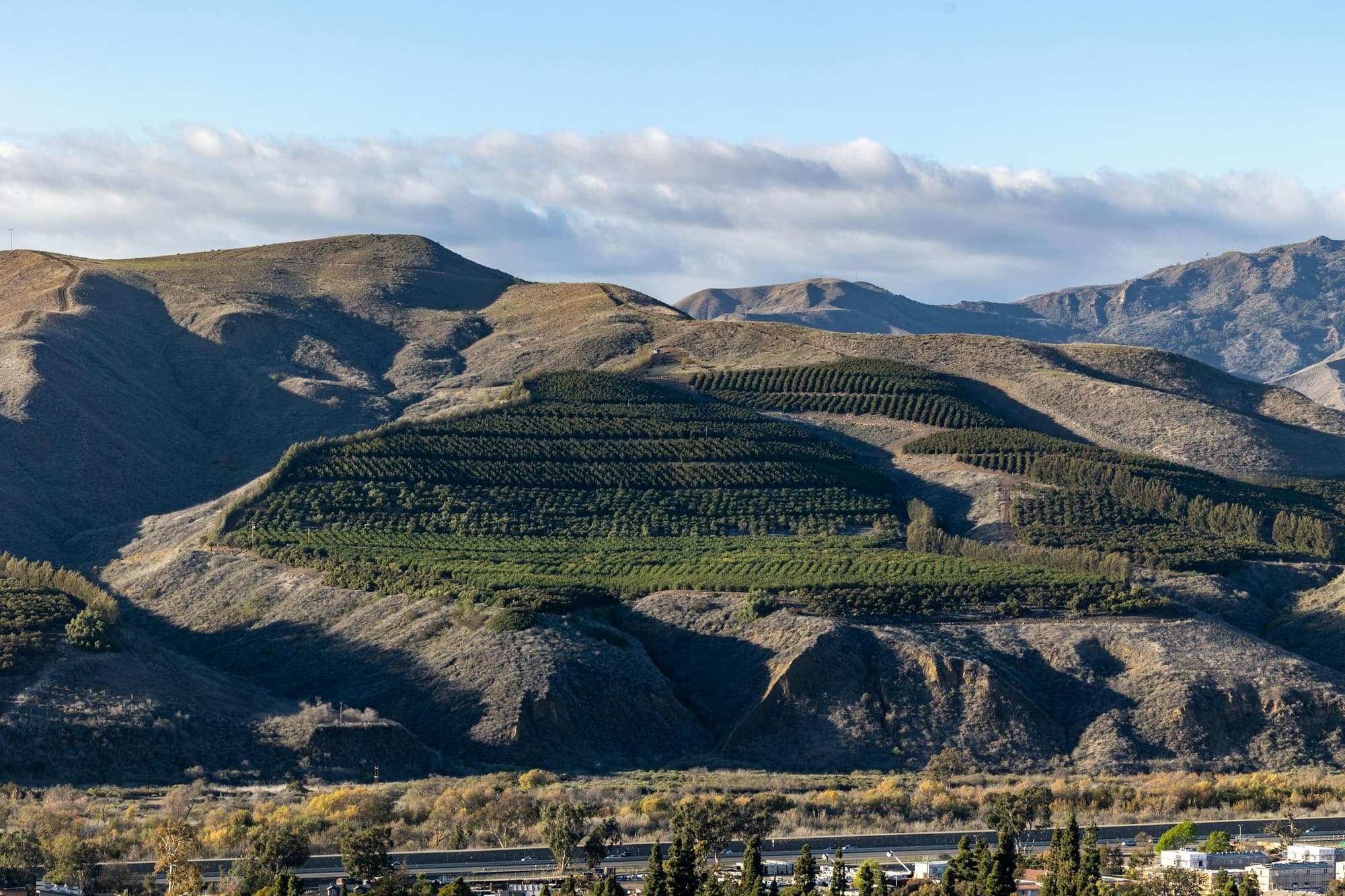
Camarillo sits about six miles inland from the coast at Oxnard, on a flat valley plain with the Conejo Grade rising sharply to the east and the Las Posas hills lifting north of the city. The geography matters because Camarillo usually sits at the inland edge of the marine layer; most summer mornings, the fog reaches Camarillo and stops, or thins to a high overcast. By midday the city is generally in sun while downtown Ventura is still gray. Summer days run noticeably warmer than the coast (typically five to ten degrees) but cooler than the Conejo Valley or the inland Simi side of the grade. Santa Ana wind events in the fall push hot dry offshore air across the city; the wind is rarely as severe here as it is in the canyons east of the grade, but fire risk in the Las Posas hills and along the Conejo escarpment is real. The Heights neighborhoods stepping up the south-facing hills get more sun, more wind, and more view than the flats; they also get more brush-clearance obligation.
The character of the city
Camarillo's character is two cities running in parallel. The flats (the gridded streets between the 101 and the Las Posas hills, anchored by Old Town Camarillo on Ventura Boulevard) are where the city's daily commerce happens: the small downtown stretch with a few good restaurants and an independent bookstore, the post-war ranch tracts that house most of the city's residential inventory, and the multifamily corridors along Las Posas, Carmen, and the Lewis-corridor pockets. The hills above (the Heights, Las Posas Estates north of town, the newer Mission Oaks development east) are quieter, more residential, with a country club layer at Las Posas dating to 1958 and architecture skewing California ranch and Mediterranean. Old Town has an antiquing and small-shop identity that's quietly authentic. The eastern edge, near the outlets and Camarillo Springs, reads more conventionally suburban. Buyers who tour only the eastern edge often miss what makes the city worth choosing; the western flats and the hills above are where the real local life happens.
Commute and access
The 101 runs through Camarillo with eight exits between Camarillo Springs Road at the eastern edge and Central Avenue at the western edge. That exit density matters because it materially affects which neighborhood you choose. Highway 34 (Lewis Road) connects Camarillo south to Oxnard and Naval Base Ventura County at Point Mugu in about fifteen minutes; that's the practical NBVC commute from the Heights. Highway 23 runs north from the 101 toward Moorpark and ultimately the 118; it's an alternative to the 101 for LA-bound traffic when the main route is jammed. To LA: Camarillo to downtown is about fifty miles and an hour off-peak, ninety minutes to two hours in worst-case Friday traffic; Camarillo to LAX is similar. To Santa Barbara: about forty-five miles and fifty minutes off-peak. There is no Pacific Surfliner stop in Camarillo proper. The nearest is Oxnard, eight miles west, with about ten daily trains. For LA-bound rail, Metrolink's Ventura County Line stops at Camarillo station near the airport with weekday service. The combination of multiple freeway exits, two highway alternatives, and a Metrolink station makes Camarillo the most commute-flexible city in central Ventura County.
Schools, plainly
Camarillo's school-district situation is more complex than buyers usually expect, and for many buyers it's the single most important pre-purchase research item. Pleasant Valley School District covers most of Camarillo proper for K-8 and is consistently among the strongest elementary districts in Ventura County. The district reputation drives meaningful buyer demand and resale support across its catchment. For high school, Camarillo falls under Oxnard Union High School District, which also covers Oxnard and Port Hueneme; quality varies sharply by site within Oxnard Union, with Camarillo High and Rio Mesa generally well-regarded among the comprehensive options. Mission Oaks and parts of east Camarillo fall under Somis Union and other smaller districts at the K-8 level, with Oxnard Union still as the high school. The catchment lines do not follow the neighborhood lines outside buyers expect, and a property two blocks apart can feed entirely different schools. Confirm the assigned schools at the address level, not the neighborhood level, before pricing decisions are finalized.
Housing stock, broadly
Camarillo's housing inventory is the most varied of the central-county cities. The flats are largely 1950s through 1970s post-war ranch and tract: three- and four-bedroom layouts on conventional lots, attached two-car garages, the bones of most of the city's larger-home inventory. Las Posas Estates, dating to 1958, carries a layer of mid-century modern and California ranch on larger parcels with the country club at the center, including some architect-signed homes from the 1960s. Camarillo Heights stepping up the hills runs from modest 1960s tract through 1990s and 2000s custom builds on view lots, with the architecture skewing ranch and Mediterranean and newer contemporaries scattered. Mission Oaks at the eastern edge is largely 1990s and 2000s master-planned single-family. The multifamily corridors along Las Posas Drive, Carmen Drive, and the Lewis-corridor pockets carry the deepest investor inventory of any city in central Ventura County under five million dollars. Buyers needing four-bedroom inventory at moderate price points generally find more options here than in Ventura proper or Ojai.
What people don't tell you
Three things. First, the school district complexity is real and creates pricing patterns the casual buyer misses. A house inside Pleasant Valley School District commands a measurable premium over a comparable house just outside the catchment, even when the same Oxnard Union high school serves both addresses. The premium is real and persistent, and it has nothing to do with the houses themselves. Second, the Heights and the Las Posas hills are in fire-severity zones with brush-clearance obligations that take genuine annual maintenance budget, typically thousands of dollars a year for hillside parcels. Insurance complications have intensified since 2018 and again post-2025; verify insurability during escrow. Third, the city's distance from coastal water and from a Pacific Surfliner station means lifestyle requires driving. Camarillo is not a walkable city outside Old Town, and buyers who wanted walkable coastal lifestyle and bought Camarillo for the price-per-square-foot often regret the trade. The Heights buyer who works from home and treats the coast as a weekend destination loves the city. The buyer who wanted to walk to the beach and compromised here often relists within two years.
Who the city actually fits, and who it doesn't
Camarillo fits buyers who need four-bedroom-plus inventory at moderate price points, who value the Pleasant Valley elementary district, who want flexible commute access via 101, 23, 34, and Metrolink, and who don't require walkable coastal lifestyle as a daily condition. It fits buyers commuting to NBVC Port Hueneme or Point Mugu: Highway 34 to Mugu and the 101 to Hueneme make Camarillo one of the most common landing points for VA-loan buyers in the area. It fits remote workers who want sun, space, and a yard, and who treat downtown Ventura or Pierpont as a thirty-minute weekend drive rather than a daily backdrop. It does not fit buyers prioritizing walkable Main Street commerce within five minutes (Old Town has it but only on its specific blocks), who want a small village identity (Ojai fits that, Camarillo doesn't), or who need ocean within a five-minute walk. It also doesn't fit buyers expecting an inland-Ventura-County price discount; the Pleasant Valley catchment in particular has held value tightly, and the Heights view lots trade closer to coastal pricing than buyers anticipate.