
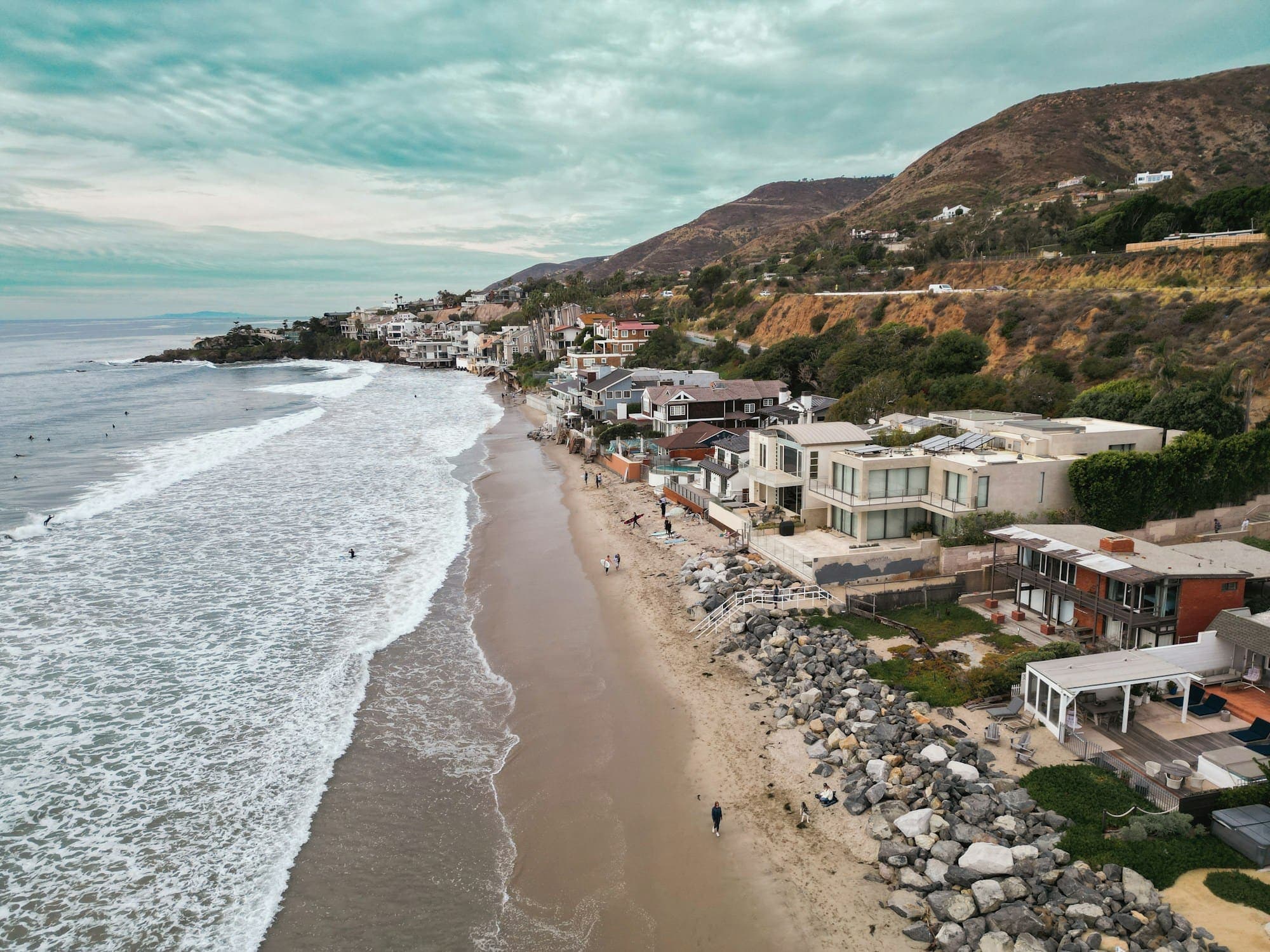
Malibu Coast is twenty-seven miles of Pacific Coast Highway frontage, a series of beach colonies (Carbon Beach, Broad Beach, Paradise Cove), and the bluff-top compounds of Point Dume. It's also a fire-prone zone with serious geological complexity. Buyers come for the beach and the privacy; due diligence has to address what happens when neither is being kind.
Who lives here
Ultra-high-net-worth buyers from the LA entertainment industry, finance professionals from the Westside, and a quieter category of long-time residents who bought decades ago and have no interest in selling. Recent buyers skew toward second-home and pied-à-terre rather than primary residence — Malibu's distance from anywhere except itself favors that.
What to know
Three things. First, the California Coastal Commission's authority over development is strong and slow — any meaningful exterior modification requires CCC review on top of LA County permits. Second, fire risk is real and insurance is increasingly difficult; insurance non-renewals and California FAIR Plan policies are now common rather than exceptional. Third, the bluff-top compounds have geological monitoring obligations and easement complications that show up in title; a clean title here is rarely literally clean.
Market character
Malibu's high end is its own market — twenty-some sales above $20M annually, largely off-market or quietly listed. The middle of the market ($5–15M) is more active and follows national luxury cycles. The lower end (under $5M, mostly inland canyon or older condo product) trades on a different rhythm than the bluff and beach categories above it. Three different sub-markets in one zip code.
Nothing listed in Malibu Coast right now.
I don’t have an active listing in Malibu Coast at the moment. Off-market work and pre-MLS introductions happen here regularly — if you’re considering buying or selling, we can start with a conversation.
Begin a conversation→Common questions.
How realistic is fire insurance on Malibu coastal property today?
Realistic but expensive and increasingly limited. Most major carriers have stopped writing new policies in the highest-risk Malibu zones; the California FAIR Plan plus a wraparound policy is the common solution. Premiums of $20,000–$60,000 annually on multi-million-dollar primary residences are now normal. Buyers should solve insurance during escrow, not after.
What are the actual differences between the named Malibu beaches?
Carbon Beach is private, gated-access, narrow but exclusive — the 'Billionaire's Beach.' Broad Beach is wider, dog-friendly, and has had ongoing sand-replenishment debate. Paradise Cove is restricted-access via the cafe; the Mobil Park leases there are unique product. Point Dume is bluff-top, not on the sand. Each has a meaningfully different lifestyle and a meaningfully different price profile.
How did the 2025 fires change the Malibu market?
The fires changed the timeline more than the long-term value. Properties that survived are trading at premiums; rebuild parcels are pricing on land value plus the considerable cost and timeline of new construction in a CCC-jurisdiction. Coastal supply here is limited, but nobody can promise how values move from here, and buyers should plan for friction at every step: permitting, insurance, and timeline.