
Climate and geography
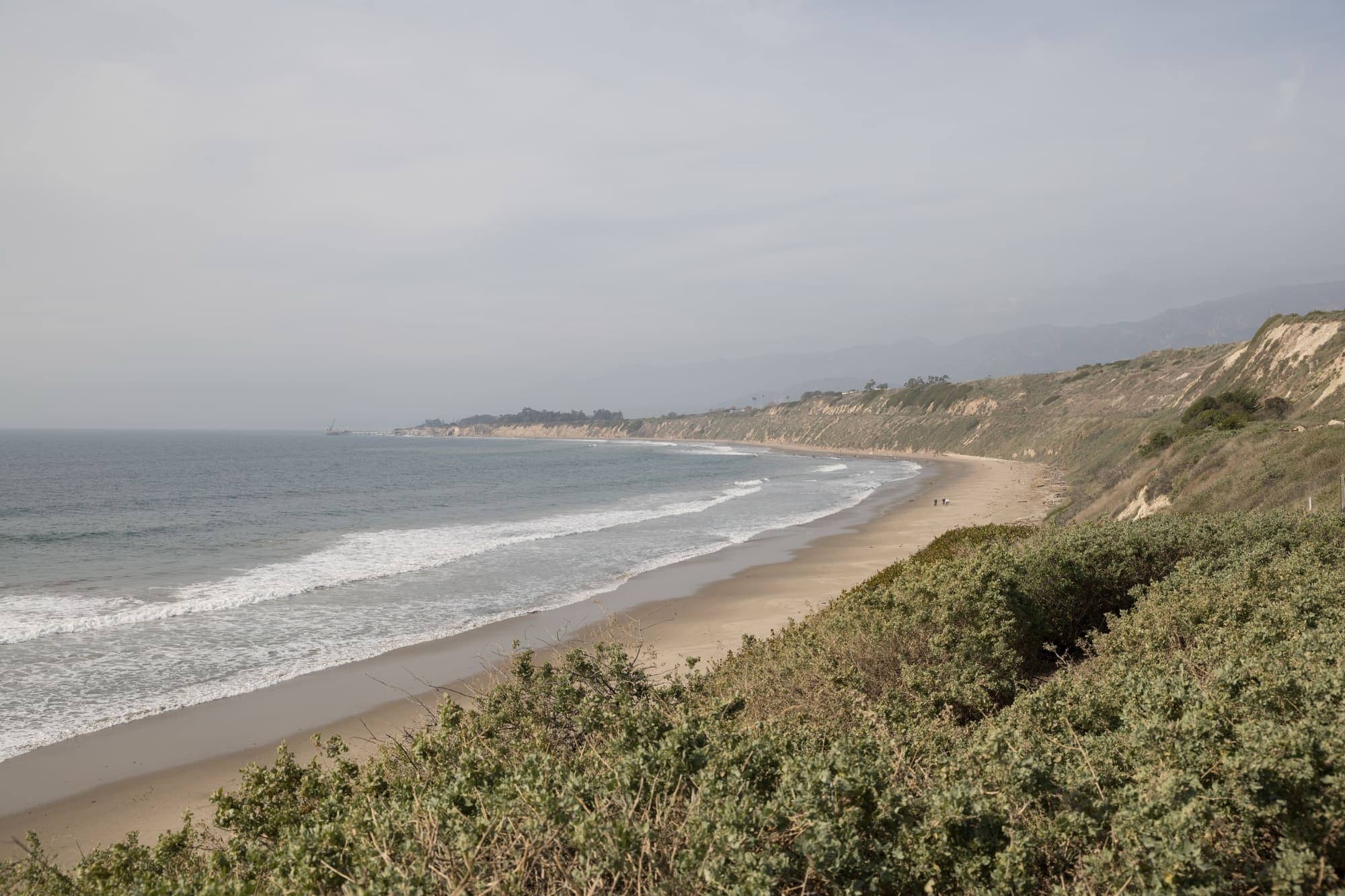
Carpinteria sits on a narrow coastal plain between the Santa Ynez Mountains and the Pacific, in a south-facing valley that captures sun and shelter from the mountains' lee. The orientation matters: most California coastlines face west, so the Santa Barbara South Coast (Carpinteria, Santa Barbara, Goleta) faces south, which delivers warmer water, calmer surf for much of the year, and a microclimate that runs a few degrees milder than coastal Ventura in winter. Marine layer is the dominant summer climate fact, as it is everywhere on the South Coast: late May through early August, mornings start gray and clear by midday. Average summer high temperature is in the low seventies. Winters are mild, with overnight lows rarely below the mid-forties at the coast. Sundowner wind events (hot dry offshore winds that descend the Santa Ynez range) are the local equivalent of the Santa Anas further south, and they create the fire conditions that drove the 2017 Thomas Fire and the 2018 mudslides at Montecito just north of here. The Carpinteria Salt Marsh, on the western side of town, is one of the few remaining salt wetlands in Southern California and shapes the climate and ecology of the streets immediately around it.
The character of the city
Carpinteria has a beach-town character that's rare on the California coast at this point: small, walkable, agriculturally rooted, and unhurried. Linden Avenue runs from the 101 four blocks south to the State Beach pier, anchoring the small downtown commercial core: the Worker Bee Bakery, Padaro Beach Grill, a few good restaurants, the surf shops, the post office, the small-format grocery. The downtown is genuinely walkable, which Thousand Oaks and Westlake Village are not, and which separates Carpinteria from most coastal cities of comparable size. The agricultural layer is real and visible: avocado groves and flower greenhouses still operate within a few miles of downtown, and the California Avocado Festival, held the first weekend of October since 1987, is the city's largest annual event. The surf community is a category unto itself: Rincon, on the eastern county line, is one of the most respected point breaks on the West Coast, and the surf identity runs through the city's daily texture. The Carpinteria Bluffs Nature Preserve and the harbor seal rookery on its eastern edge are the city's signature open-space asset; the seal sanctuary is one of only four in Southern California and is genuinely public-accessible. Buyers comparing Carpinteria against Santa Barbara expecting the same curated upper-village luxury experience will misjudge it. Carpinteria is intentionally more modest in scale and posture.
Commute and access
The 101 runs through Carpinteria parallel to the coast, with three exits between Bailard at the eastern edge and Santa Monica Road at the western. Northbound to Santa Barbara: downtown is about twelve miles and fifteen minutes off-peak, twenty-five to thirty in evening traffic. Northbound to Goleta and UCSB: about twenty-five minutes off-peak. Southbound to Ventura: downtown Ventura is twenty-six miles and twenty-five minutes off-peak; the 101 routinely jams on Friday afternoons northbound and Sunday afternoons southbound through this stretch. The Pacific Surfliner stops at the Carpinteria station on Linden Avenue with multiple daily trains running San Luis Obispo to San Diego, a meaningful asset for buyers who want car-free access to Santa Barbara, LA, or San Diego. Metrolink does not serve Carpinteria. The combination of Surfliner access, walkable downtown commerce, and short freeway commute to Santa Barbara is one of the reasons Carpinteria's relative-value story has tightened over the last decade. Buyers who would have anchored in Ventura proper or Santa Barbara have increasingly recognized Carpinteria as a credible middle.
Schools, plainly
Carpinteria Unified School District covers the city: a small district with Carpinteria High School, Carpinteria Middle School, Aliso Elementary, Canalino Elementary, and a small alternative-program network. The district is small enough that buyers can generally confirm which school an address feeds with a phone call to the district office, and the parent involvement is high. Carpinteria High is the comprehensive public high school option; for buyers weighing other options, Bishop Diego (Catholic) and Cate School (private boarding, in adjacent Carpinteria foothills) are the well-known independent alternatives. Cate, in particular, is one of the better-known boarding schools on the West Coast and operates on its own admissions calendar separate from the public district. Buyers weighing high school options should evaluate Carpinteria High carefully; the district is small enough that the specific school's culture is a primary fit consideration rather than the district average.
Housing stock, broadly
Carpinteria's housing inventory is more compact and more varied than its population suggests. The downtown grid (the streets between Linden Avenue and the bluffs, between the salt marsh and Bailard) carries 1920s through 1950s beach-cottage and Spanish-influenced inventory on small lots, with a layer of mid-century post-war ranches and newer infill custom builds. The streets immediately above the 101 (the 'Mountain' side) carry larger lots and 1960s and 1970s ranch inventory with foothill exposure. The Padaro Lane and Sand Point Road corridor, on the eastern beach side, is the trophy submarket: multi-million-dollar oceanfront and ocean-view estates on large parcels, a different price tier and a different category from the downtown core. The Carpinteria Avenue corridor and the streets north toward the avocado groves carry mixed agricultural-residential inventory, including some working orchard parcels still in production. Buyers looking for downtown walkability look at Linden, Walnut, and the streets immediately east; buyers looking for foothill quiet and larger lots look mountain-side; buyers looking for oceanfront trophy property look at Padaro and Sand Point. The downtown inventory is the slowest-moving; long-time owners hold for decades, and active inventory rarely exceeds fifteen single-family listings citywide.
What people don't tell you
Four things. First, short-term-rental supply is constrained by ordinance. Carpinteria's STR overlay district, established by Ordinance 708 in 2017, limits permitted short-term rentals to specific zones with hard caps on permit count by zone. STR underwriting that assumes Airbnb-style flexibility will be wrong; verify the permit status and the zone cap with the city before any STR-investment math. Second, the Carpinteria Bluffs and the Salt Marsh are protected open space, which is part of what makes the city's character durable but also constrains future buildout. Properties adjacent to either carry coastal-overlay considerations that affect addition, ADU, and remodel permitting; expect longer permit timelines than inland Santa Barbara County. Third, the 101 noise corridor is real. Properties within two or three blocks of the freeway, particularly between Bailard and Santa Monica Road, get measurable highway hum at night when conditions carry. Spend an evening at the property before close. Fourth, fire and post-fire flood risk is genuine. The 2017 Thomas Fire burned to within a few miles of the city, and the 2018 Montecito mudslides, driven by post-fire watershed instability, affected the highway corridor immediately north. Insurance availability has tightened materially since 2018; verify insurability during escrow.
Who the city actually fits, and who it doesn't
Carpinteria fits buyers who want true small-town coastal character (walkable downtown, working surf community, agricultural setting) and who recognize that the South Coast pricing tier is real but more accessible here than in Santa Barbara proper or Montecito. It fits buyers who actively want the bluffs, the salt marsh, the harbor seal sanctuary, and the avocado-festival-and-state-beach rhythm as part of daily life. It fits households whose work allows car-free access via the Pacific Surfliner two or three days a week, or whose daily commute is fifteen to twenty-five minutes north into Santa Barbara or Goleta. It fits buyers wanting trophy oceanfront on Padaro or Sand Point at meaningfully lower entry than Montecito's beach corridor, while accepting that the trade-off is a smaller commercial core and a more modest lifestyle posture. It does not fit buyers expecting Santa Barbara's curated upper-village luxury experience; Carpinteria is intentionally different. It does not fit buyers needing four-bedroom inventory at moderate prices on conventional lots; the inventory skews compact and the pricing skews coastal. It does not fit a four-week PCS-window buyer search; downtown inventory is too thin and the off-market percentage is too high.