
Architectural Spotlight: the post-war ranches of Montalvo
On the southeast corner of the city, where the rail junction came first and the houses came after — what a 1956 Ventura ranch was actually built to do, and why I think the submarket is read short.
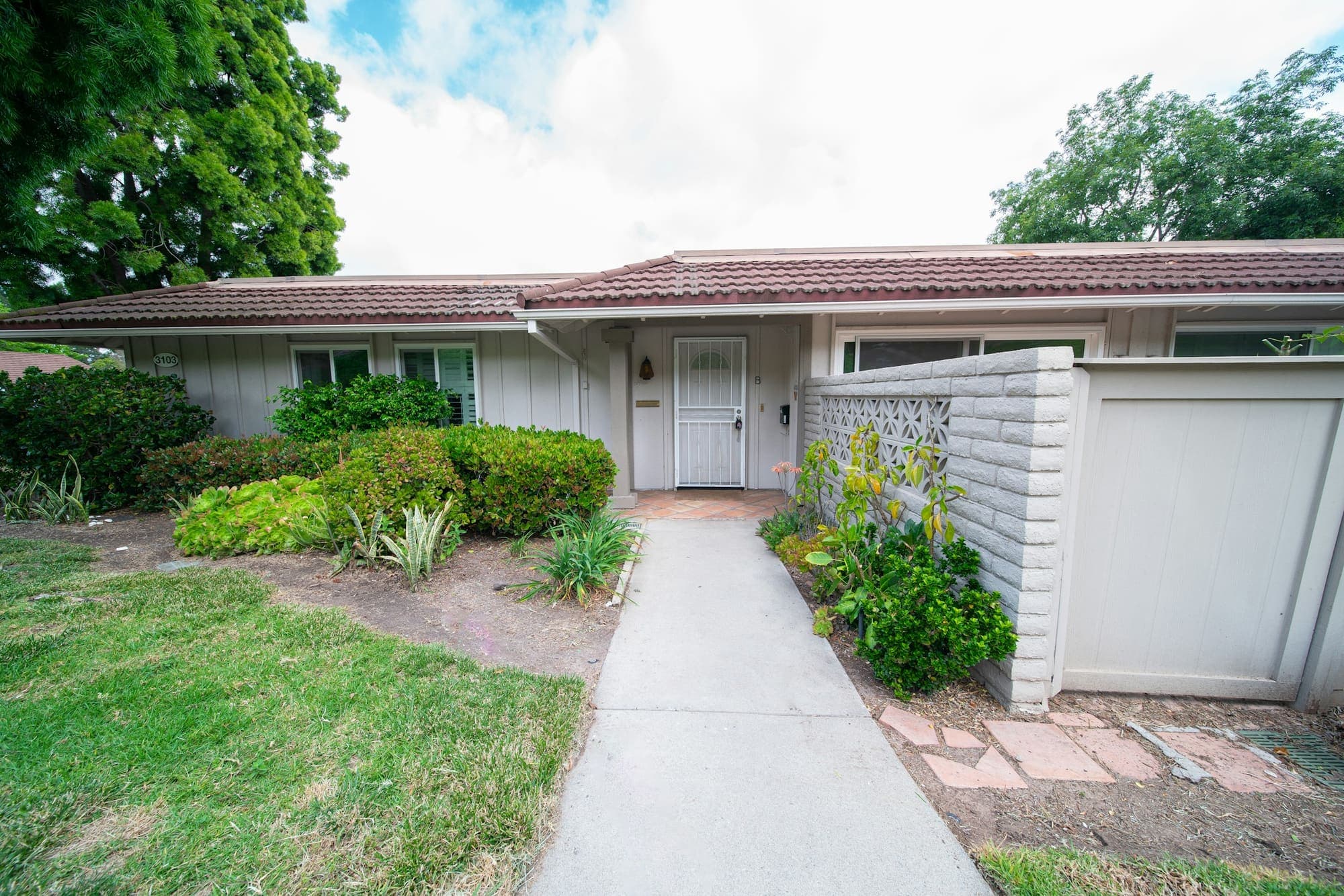
I was on a walk-through off Johnson Drive on a Tuesday morning, on a street I have been on more times than I can count, and I caught myself standing in the driveway longer than the appointment required. The house was a 1956 three-bedroom on a wide flat lot: low-pitched gable, a 24-inch eave running unbroken across the front, an attached single-car garage set back from the main mass with a short breezeway between them. The fascia was a single redwood 1×8, weathered but original. The front-facing window was a horizontal three-lite with the muntins still in place. From the curb the silhouette was almost the same as it had been when the framer walked off the job seventy years ago, and most of what made it that way was things a casual buyer wouldn't notice.
This is the part of Montalvo I think about most. The southeast corner of the city — the streets between Telegraph Road and the river, the grid that fills in around the old Montalvo junction — is the most architecturally consistent stretch of post-war single-family stock inside Ventura's city limits. It is also, in my view, the most under-read submarket the city has.
How Montalvo got built
Montalvo was its own place before it was part of Ventura. The community was founded around 1887 as a stop on the Southern Pacific line (the Montalvo junction is where the coast route from Los Angeles met the line running inland toward Santa Paula and the Santa Clara Valley), and for a stretch in the late 1880s it had its own hotel, its own newspaper, and a real downtown along what is now the railroad corridor. Most of that was gone by the 1920s; Oxnard's growth pulled the commercial center across the river, and what survived in Montalvo was the rail infrastructure and a handful of original parcels.
The housing stock most buyers see today came later, and it came in two waves. The first wave was the immediate post-war years: the Farr brothers' tracts on Channel Drive, Katherine Avenue, Bristol Road, and the original Montalvo Drive corridor, built between roughly 1945 and 1949 for returning veterans. The second wave was bigger and ran through the 1950s and into the early 1960s, with Bartlett and Ramelli's Montalvo Heights developments filling in the Johnson Drive area. By the time the community was folded into the city of Ventura through annexation (voted down in 1992 and finally completed in September 2012), Montalvo had been a settled residential neighborhood for two full generations.
The rail junction is still there. The Metrolink terminus at Ventura–East — which carried the name "Montalvo" until the 2011 rename — is the south end of the Ventura County Line and the reason there is overnight train storage on this side of town rather than downtown. Whether that's an asset or a footnote depends on the parcel; on streets close to the corridor it is an audible presence, on streets a few blocks away it isn't.
What the period actually built
The Montalvo ranches are not Cliff May ranches, and they are not Eichlers. They sit in the broader California ranch lineage that the period produced at scale — Cliff May's San Diego work in the early 1930s set the vocabulary, and by the 1950s the ranch silhouette accounted for something like nine of every ten new houses being built in California — but in Montalvo the version that landed was the practical, builder-driven one. Single story. Low-pitched gable or hip roof, almost never above a 4:12 pitch. Wide eaves with a 16- to 24-inch overhang. An attached single-car garage, often with a short breezeway connecting it to the main mass. Stucco walls with a board-and-batten accent at the entry or under the front gable. A picture window or a horizontal three-lite at the living room, ribbon-height clerestory glass at the kitchen and the rear bedroom.
The lots are the other half of the story. Most original Montalvo parcels run between 6,000 and 8,500 square feet, meaningfully larger than Pierpont's 2,700-square-foot beach-cottage lots, and a different proposition entirely. The footprint of the original house typically uses less than a quarter of the parcel, which leaves a real backyard, room for a detached structure off the rear setback, and — under the ADU rules the City of Ventura adopted in 2023 and the state-level updates that took effect in January 2026 — genuine accessory-dwelling capacity that the tighter beach-side submarkets simply cannot match. A flat 7,200-square-foot Montalvo lot can accept a detached ADU of up to 1,000 square feet (or 1,200 for two-bedroom plans on the larger parcels) with a four-foot rear and side setback. That is a different kind of lot to work with.
What good remodels do here is leave the silhouette alone, restore the original fascia and eave depth, replace aluminum slider replacements with wood-clad windows in the original openings, and put the addition on the back where it doesn't disturb the street elevation. What bad remodels do is raise the roof, infill the breezeway, swap the original front window for a centered modern picture window with no muntins, and clad the front in a smooth one-coat stucco that erases the period texture. I have walked through both. The first reads as a careful restoration. The second reads as a 1956 house that someone tried to make look like a 1996 house and produced something that looks like neither.
Honestly, the trade-offs
I want to be straight about what Montalvo is not. The submarket is closer to the 101 than Pierpont or Hillside, and on the streets nearest the freeway the noise is a real factor — the kind of thing that should drop a property a tier in your ranking, not stop the conversation. Parts of the southern edge of the neighborhood sit close enough to the Santa Clara River corridor that flood-zone designation matters; the levee work along the SCR-3 reach is improving the picture but a buyer should pull the FEMA panel before writing an offer. The school assignment within Ventura Unified is a parcel-by-parcel question. Montalvo Elementary, the dual-language magnet on Grand Avenue, anchors the southern half of the neighborhood, but middle and high school assignments cross attendance boundaries, so verify school assignment by address before close.
And the architectural inventory is finite. There is no historic overlay, no design review, no preservation easement on any of this stock. What survives in original condition survives because the owner chose to keep it. The same fragile arrangement holds in Camarillo Heights, with the same slow contraction of authentically detailed examples each cycle. The good news is that on the right block the originals still dominate; the bad news is that the next remodel can change that.
Why I think the read is short
This is editorial, and I want to mark it as such. In my view Montalvo is the most accessibly priced submarket inside the Ventura city limits, comparatively speaking. The same buyer who is priced out of Pierpont, Downtown, or the Hillside view streets will find materially more lot, more original architecture, and more ADU capacity here for the dollar. That comparison is real and worth running honestly. It is not a prediction about where prices go from here, and I don't make those publicly; it is an observation about what a parcel of a given size and quality costs in Montalvo versus three miles west.
Montalvo has been part of my practice for more than 25 years: through the annexation debates, through the freeway reconfiguration, through the slow re-rate that followed the city's eastward expansion. What I keep coming back to, on the walk-throughs, is how much of the original architectural intent is still legible if you know how to look for it. The 1956 ranch I started this piece in had its breezeway intact, its eave depth intact, and a redwood fascia that had been painted but not replaced. The owner walked me through the kitchen and pointed at the clerestory ribbon above the sink — original to the house, never altered, doing exactly what the framer designed it to do. There aren't as many of those left as there used to be. There are still more in Montalvo than people assume.